
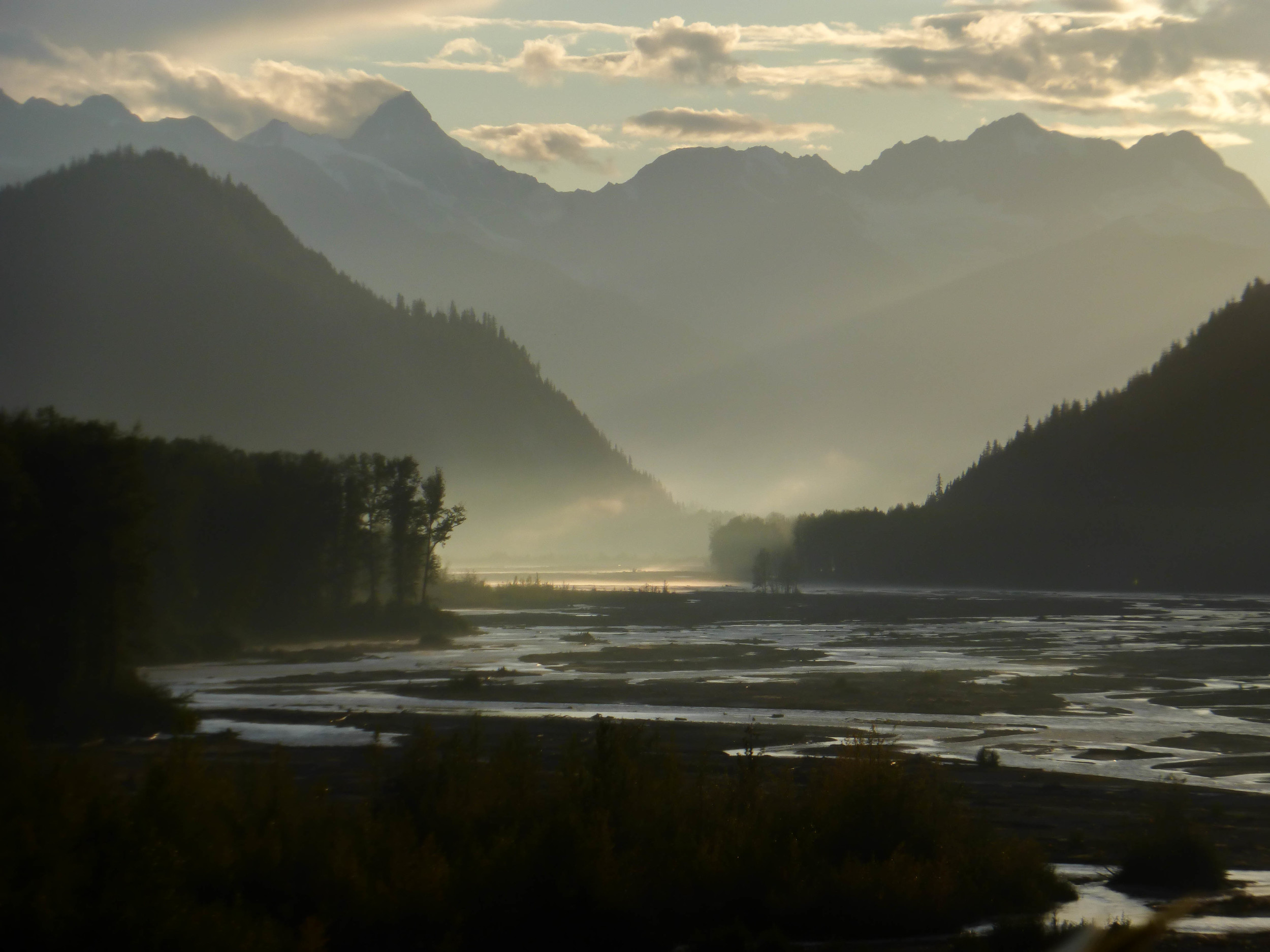
Vancouver-based American Pacific Mining (APM) wants investors to believe the Palmer Copper-Zinc Project near Haines has a high potential for profit. If so, why did the giant Japanese minerals company DOWA walk away last November from a ten-year investment of tens of millions of dollars? Why does APM suddenly want to sell the prospect and leave Alaska?
Here are five reasons the economic uncertainties, ecological risks and social negatives far outweigh the project’s highly speculative potential profits:
1. Access, climate and geography challenges
The proposed mine site is partially covered by the Saksaia Glacier, and experiences very high annual precipitation rates (rain and snow), landslides, avalanches and earthquakes. The site will be challenging to develop and nearly impossible to control.
APM touts the site’s proximity (37 miles) to the deep-water port in Haines, stretching the truth even further. The Lutak Dock facility lacks ore transfer capability and has been collapsing into Lutak Inlet for decades. Most of the dock is closed to the public due to safety concerns.
2. A profitable mineral resource has yet to be demonstrated
Independent geologists describe the ore body as folded, faulted, discontinuous and with varying ore thickness and grade, making it difficult to assess and ultimately to mine profitably. APM’s 2019 Preliminary Economic Assessment predictions relied on operating costs far less than other operating mines in the region, and the dubious profitability of marketing barite.
Further definition of the ore body’s geometry and grade will require blasting a mile-plus-long exploration tunnel beneath the Saksaia Glacier. Hundreds of thousands of gallons of wastewater contaminated with silt, hydrocarbons, explosives residues, and heavy metals (once the ore body is reached) will be draining from the tunnel every day and require treatment in perpetuity before reaching the nearby Klehini River.
The Haines economy is based largely on the abundance of fish, eagles and bears living in the Chilkat Valley. Aside from the pollution risks, the long-term socio-economic impacts of siting large resource extraction projects near small rural communities are well known: social disruption from the introduction of hundreds of transient workers into an isolated area and forcing a conversion to a boom-bust mining economy.
Many residents of Haines and Klukwan strongly oppose the project because it threatens the region’s salmon runs that are a critical source of local food and have been a fundamental component of the local culture for millennia. The American Bald Eagle Foundation and National Eagle Center are on record in opposition to the mine’s development.
Despite claims to the contrary, APM and its previous joint-venture partner DOWA have never seriously engaged with the public to discuss whether the project should happen under any circumstances.
4. A world-class ecosystem is worth far more than an unproven base-metals (copper/zinc) deposit
The Alaska Chilkat Bald Eagle Preserve is home to the largest congregation of eagles on Earth.
APM appeared overjoyed at gaining 100% control of the Palmer Project in late 2024 when DOWA walked away from the joint venture. But without DOWA, APM hasn’t had enough funding to keep the project going. In an April 2025 video interview (Doug Casey’s Experts Roundtable) APM CEO Warwick Smith stated they are now looking to “transact” (i.e., sell) the project, because it is “outside of our wheelhouse”, there are “better groups that are more well-suited towards Alaska than we are”, and Palmer should end up with “an Alaska-based company.” After so many years of controversy, conflict and hype, if APM still believes the Palmer Project could be highly profitable, why sell out now?
Mining is always a gamble, but putting money down on the Palmer Project is a sucker’s bet.
Gershon Cohen is project director of Alaska Clean Water Advocacy, has lived in the Chilkat Valley for over 40 years and has been working to protect Alaska’s waters and fisheries resources since 1990.
Cindy Buxton is a retired independent consulting geologist with 20+ years doing geologic modeling of large underground mineral deposits in Alaska and Canada. Cindy has lived in the Chilkat Valley for over 20 years.
Joe Ordonez is founder/president of Rainbow Glacier Adventures based in Haines and author of “Where Eagles Gather, the Story of the Alaska Chilkat Eagle Preserve.” He has been guiding in the Preserve since 1986.